
 Q4 Financial Review
Tokyo Cement Group (Tokyo Cement) reported a turnover of Rs. 17,623 million for the 4th Quarter ending 31st March 2026, compared to Rs. 12,960 million recorded in the corresponding quarter of the previous year, reflecting a 36% growth in turnover.
The Group reported a Profit After Tax (PAT) of Rs. 577 million for the quarter, compared to Rs. 664 million recorded in the same period last year. Profitability during the quarter was impacted by depreciating currency and rising material costs, as a result of the geopolitical disruptions affecting global trade flows.
FY 2025/26 Financial Review
For the Financial Year ending 31st March 2026, the Group reported a turnover of Rs. 61,011 million, compared to Rs. 50,096 million recorded in the previous year, representing a 22% growth in turnover. During the Financial Year, the Group recorded a 28% growth in cement sales volumes, significantly outperforming the overall industry growth of 19%, further strengthening its position as the market leader.
The Group reported a PAT of Rs. 2,580 million for the year, compared to Rs. 3,459 million recorded in the previous Financial Year. Profitability was impacted by the Group absorbing a substantial portion of cost escalations in order to minimise price volatility for end consumers and safeguard market share in an intensely competitive environment. Furthermore, capitalization of the capacity expansion projects and the acquisition of a vessel for coastal shipments increased Depreciation and Financial Expenses.
The Economic Environment
The resumption of previously stalled government-funded infrastructure and private-sector construction projects drove an increase in demand for cement and concrete through the Financial Year. This demand momentum was further compounded upon by the cyclical increase in construction activities during the January-March period and the post-Ditwah rebuilding efforts. Consequently, national cement consumption recorded a year-on-year increase of 19% to 5.62 Mn MT during the Financial Year.
Whilst the encouraging financing environment and stable material prices continued to support sector growth, persistent challenges in sourcing skilled and unskilled labour remained one of the most critical constraints faced by the industry.
Macroeconomic conditions over the course of the Financial Year remained relatively resilient, supported by strong fiscal performance, rising remittance and foreign exchange inflows, subdued inflation, and robust private sector-led growth. However, escalating geopolitical tensions disrupted raw material imports and increased costs in the last quarter, leading to price increases across sectors. As a result of the economic shock, the Sri Lanka Purchasing Managers’ Index (PMI – Construction) recorded the highest (January – 75) and lowest (March – 57) indices since April 2025.
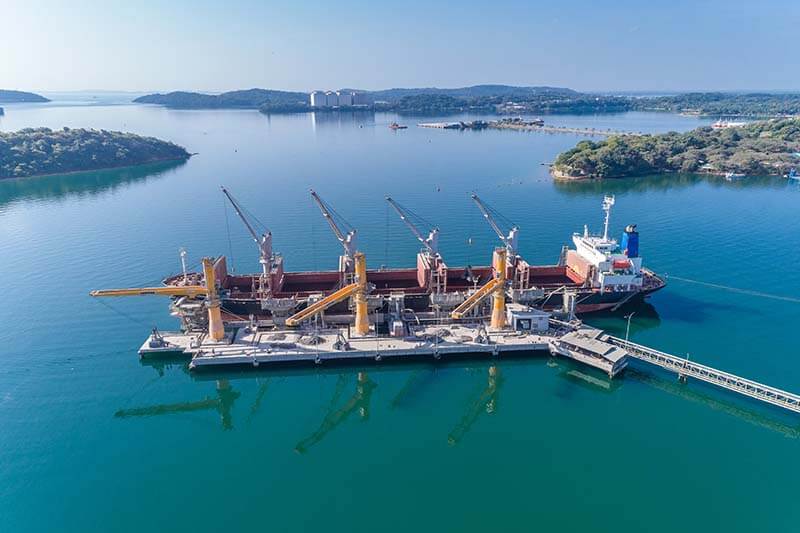
The Rupee which appreciated against the USD by 1.6% and 1.9% in Q1 and Q2 respectively, started to depreciate by 1.1% in Q3 and 6.0% in Q4 of FY2025/26. The risk of eroding fiscal buffers continued on to the Q1 of FY2026/27, where the Rupee depreciated a further 1.7% against the USD. During the quarter, fuel prices were raised by 38%, driving up operations and distribution costs across industries. Deployment of the new vessel for coastal shipping helped improve distribution efficiency from Trincomalee to the rest of the country, while also reducing exposure to fuel shortages and transport delays.
Outlook
External shocks continue to pose a significant risk to macroeconomic stability, with constrained export prospects, potential disruptions to foreign remittance inflows, and the resulting weaker purchasing power moderating economic activity. Elevated energy prices, currency depreciation, and disruptions to trade flows, tourism, freight movement, and foreign exchange markets will continue to weigh negatively on economic activity and investor sentiment.
The local value-adding manufacturing sector commenced the Financial Year 2026/27 against a backdrop of rising fuel, energy, raw material, and freight costs, resulting in significant margin pressures in the short-term. In response, companies will be compelled to adopt prudent pricing adjustments to sustain profitability while safeguarding market share within a highly competitive and price-sensitive environment. Accordingly, earnings are expected to remain subdued in the short- to medium-term as businesses may prioritise volume growth.
The Group anticipates weaker demand during the first Quarter of the new Financial Year due to adverse weather conditions, cautious investor sentiment, and broad-based increases in material prices deployed by both local manufacturers and importers. Whilst economic uncertainty may impede the commencement of new investments, ongoing projects are expected to proceed with relatively limited disruption.
Nevertheless, the recent appointment of local contractors for the Rambukkana-Galagedara section of Phase II of the Central Expressway is expected to contribute positively to sector growth, whilst the timely commencement of other large-scale infrastructure projects proposed under the 2026 Budget is anticipated to further reinforce construction demand in the months ahead. In addition, the acceleration of post-cyclone reconstruction of housing, transport infrastructure, schools, and other critical public assets is expected to sustain construction sector activity during the remainder of the calendar year.
Tokyo Cement maintains a cautiously optimistic medium-term outlook and remains confident in the country’s economic fundamentals. The Group’s investments in capacity enhancements positions it to capture the anticipated growth in demand arising from renewed development activity. Continuing its disciplined cost management approach, Tokyo Cement Group remains committed to safeguarding stakeholder value and playing an active role in supporting the nation’s economic resurgence. —